Picture Chirton, on the edge of North Shields, in the spring of 1653. It’s quiet, mostly fields, a handful of cottages. Then a group of armed men from Newcastle turns up at one particular door.
They aren’t soldiers on a battlefield.
They’re there on behalf of the most powerful town in the North East, and they’ve come for one man: a young brewer called Ralph Gardner.
By the time they leave, shots have been fired at his servants and his wife has been beaten.
His crime? Brewing beer in North Shields without Newcastle’s permission!
It sounds comical now. But for the people living at the mouth of the Tyne in the 1600s, it was deadly serious. And Gardner’s fight against it, much of it carried out from a prison cell, is one of the best stories you’ve probably never heard about this corner of Tyneside.
So who was Ralph Gardner?
He wasn’t a rabble-rouser or a lord. He was, by most measures, a fairly ordinary local businessman. That’s what makes his story so good.
Gardner was born around 1625. Funnily enough, he had Newcastle roots: his father had been a writing master at the Newcastle Grammar School, until he was let go. You’ll also see the family name spelled Gardiner in old records, which is how it appears on the title page of his famous book.
In September 1648 Ralph married Catherine Reed. By around 1650 the couple had settled in a small cottage at Chirton, then a village just outside North Shields. He was in his mid-twenties, newly married, and building a life.
He was also a respected figure locally. He served as a churchwarden in North Shields, and he had business interests in two of the biggest trades on the river: brewing and coal.
So far, so sensible. A young man with a family, a business, and a place in his community. The problem was where that business was. Because in 1650s Tyneside, brewing beer for sale at Shields wasn’t really a business decision. It was a legal one.
Newcastle’s grip on the Tyne
To understand why a brewer ended up in prison, you need to know who actually ran the river.
The short answer: Newcastle did. All of it. The town’s Mayor and Burgesses held control of the Tyne from the river mouth at Shields right up to beyond the Tyne Bridge. That meant they controlled the trade that flowed along it, and above all, the coal trade.
Coal was the big one. Tyneside coal heated London, and the money it generated was enormous. Running much of that trade was a powerful Newcastle merchant guild called the Hostmen. If you wanted to do business on the Tyne, you did it on their terms.
It wasn’t just coal, either. Back in 1446, an official inquiry had recorded that Newcastle held a monopoly on all common baking and brewing for sale anywhere within the port of Tyne. Two hundred years later, Newcastle was still treating that as gospel.
Now think about North Shields. It sat right at the mouth of the river. Every ship coming in or going out passed its door. Sailors needed bread, beer and supplies, and Shields was the obvious place to get them. The town was important enough that King Charles I himself visited North Shields in 1633, largely because of its place in the coal trade.
But legally, Shields was supposed to stay in its lane. It didn’t even have its own market. The natural way for the town to grow was blocked, again and again, by the town upriver.
You can probably see where this is going. A young, ambitious brewer at Shields, selling beer to the busiest stretch of river in the North. To Newcastle, that wasn’t enterprise. It was trespass.
Locked up, without a trial
Newcastle’s first move was the usual one: fines. Gardner was told to shut his brewery down. He refused.
So in August 1652 he was arrested, over the fines he hadn’t paid, and taken to Newcastle’s prison. By his own account it was a bare arrest. He even offered bail, with freemen of Newcastle willing to stand for him.
It didn’t help. Gardner was held for five months without a trial.
Let that sink in for a second. No hearing. No jury. No chance to put his side to a judge. Just a man from North Shields, sitting in a Newcastle cell, because the people who ran Newcastle didn’t like where he brewed his beer.
Then, in February 1653, he got out. Accounts written in the 1880s say he broke free from the jail and stayed at liberty for about three months. Whether he climbed, bribed or simply walked out, the records don’t really tell us, which is a shame, because it would make a cracking scene.
His freedom didn’t last. In May 1653, the armed party from Newcastle arrived at Chirton. Shots were fired at his servants. His wife Catherine was beaten. And before long, Gardner was back behind bars.
This is the bit that stops the story being a quaint tale about beer. A town authority sent armed men to a private home, used violence against a woman and household staff, and locked a man up again, all to protect a trading privilege.
Fighting back with a pen
Here’s where Ralph Gardner goes from victim to hero.
He didn’t give up, and he didn’t try to fight Newcastle with fists. He fought it with paperwork, which was a much braver choice than it sounds. By 1653, aged just 28, he was petitioning Parliament. And it’s thought that during his time in confinement he wrote much of the book that would make his name.
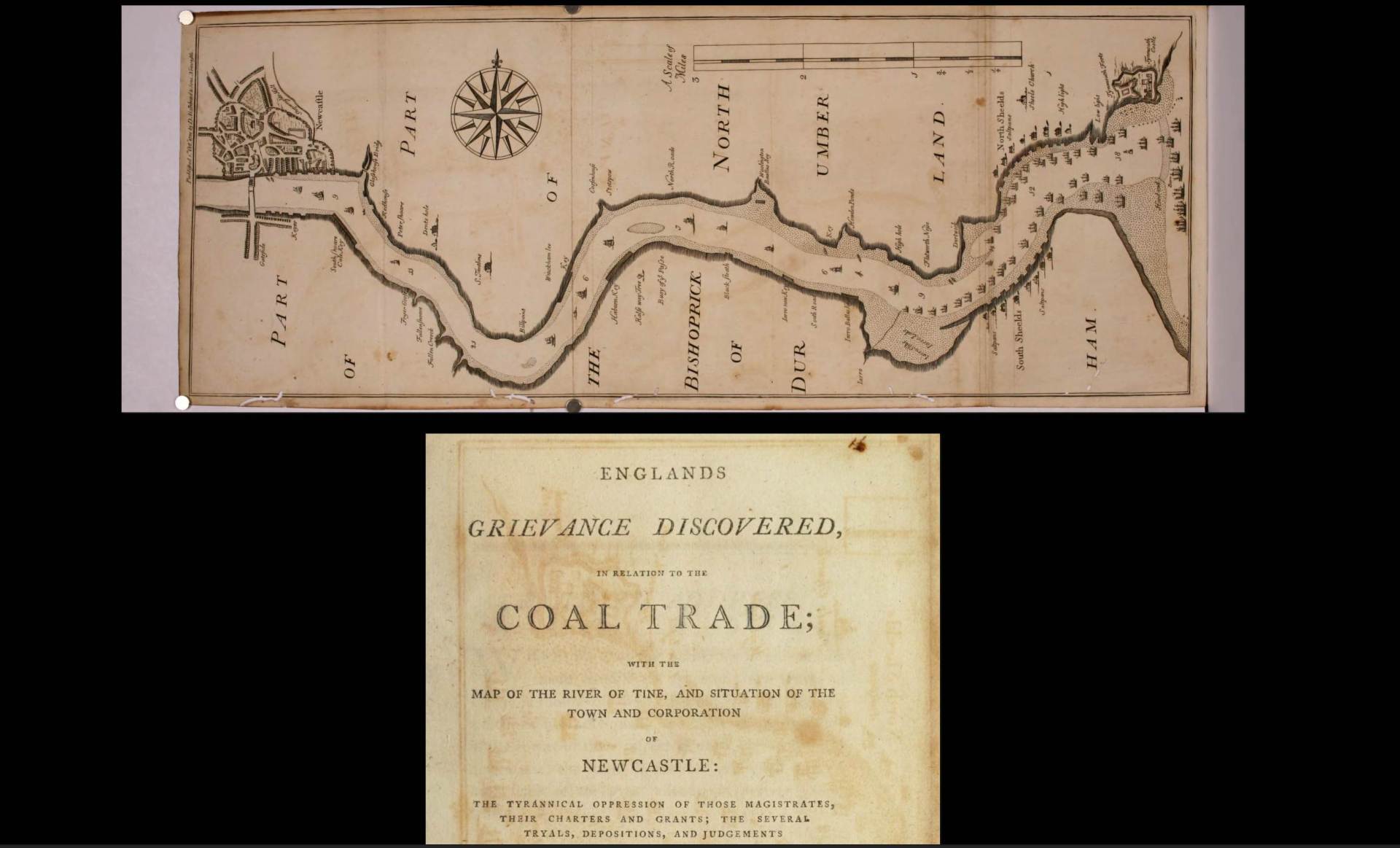
It came out in London in 1655, under a title that doesn’t exactly trip off the tongue: England’s Grievance Discovered, in Relation to the Coal Trade. And he didn’t address it to just anybody. He dedicated it to Oliver Cromwell, the Lord Protector, the most powerful man in the country.
This wasn’t a rant. It was built like a legal case. Gardner gathered up charters, court records, trials, depositions and judgments, the official evidence of how Newcastle ran the river. He set it out piece by piece to show the wrongs being done, not just to him but to Shields, to the coal trade, and to the country paying for its coal.
It was visual, too. The book included a map of the Tyne and a set of engravings, including scenes showing what he presented as the cruelties of Newcastle’s rule over the river.
And he made two big asks. First, that North Shields be granted its own market, which he argued would save lives as well as help trade. Second, and more boldly, free trade for everyone. To Gardner, monopolies and the charters that protected them were the greatest grievance a commonwealth could suffer.
Read that again, and remember when it was written. Over three and a half centuries ago, a brewer from Chirton was making the case for fair competition and the rule of law over local privilege. Historians now count his book among the earliest works ever written about the English coal trade.
There’s a lovely footnote, too. The book was reprinted in Newcastle itself in 1796. Somewhere, the old Hostmen must have been spinning.
Did he win?
Not straight away, no. Gardner’s petition didn’t get him the market for Shields, and Newcastle’s privileges weren’t swept away overnight. If you like your stories with a neat Hollywood ending, this isn’t one.
But the long game is a different matter. The Hostmen’s grip did start to weaken over time, and North Shields kept growing whether Newcastle liked it or not. By 1849 it had been incorporated as a borough in its own right. The town Newcastle had tried to keep small became a proper place, with its own town hall, its own courts and its own voice.
As for Gardner himself, he simply fades out of the record, which only adds to the mystery.
The last official trace of him is a curious one. It turns up in the 1662–63 accounts of Newcastle’s own bakers and brewers, which record payments for his services. Nobody seems quite sure what those services were. But there’s something wonderfully ironic about the man who fought Newcastle’s brewing monopoly ending up in the brewers’ account books a decade later.
After that, nothing. There’s no record of when or where he died. For a long time a story went round that he’d been hanged at York, which would have made a dramatic final chapter. Local historians have looked into it, and that claim has been thoroughly disproved. So Ralph Gardner, the man who documented everything, left no record of his own ending.
A faithful son of Father Tyne
North Shields didn’t forget him though…

Ralph Gardner Memorial in north shields. Source: Google Maps.
In 1882, more than two centuries after his fight, the town put up a memorial to Gardner at Chirton Green. On its west side it calls him “a faithful son of Father Tyne”. It’s still there, and it’s worth a detour next time you’re passing. Most people walk by without a second glance, which is a shame, because it marks one of the earliest stands for fair play in the region’s history.
There’s a nice bit of timing to all this, too. North Shields has been marking 800 years as a town, and Gardner’s map of the Tyne still turns up in discussions of how the river and the town grew up together. It’s a reminder that the tension between Shields and Newcastle is very old indeed, and that it shaped the place we know today.
So if you’re a Newcastle reader, here’s a gentle challenge. Next time you’re down at the Fish Quay with a pint, or heading out to Tynemouth, raise a glass to Ralph Gardner. The beer at the mouth of the Tyne wasn’t always yours to enjoy freely. Somebody went to prison for it.
Why Gardner’s story still matters
It’s easy to read all this and think, well, that was the 1650s. Things are different now. And they are, but not by accident.
Look at what actually happened to Gardner. He was arrested and held for five months without a trial. He offered bail and it got him nowhere. He had no real way to challenge the people locking him up, because they were the same people who stood to gain from it. When he finally got a hearing of sorts, he had to write a whole book and send it to the head of state to get it.
Today, pretty much every one of those things would be unthinkable. If you’re arrested, you have the right to free legal advice at the police station. There are strict limits on how long you can be held without charge. Bail decisions are made by independent courts, not by your business rivals. And if you can’t afford a lawyer, legal aid exists so that money isn’t the thing standing between you and a fair hearing.
None of that fell from the sky. It was won, bit by bit, by people pushing back against power that had too little to answer to. Gardner was one of them, and he did it from right here.
It’s still local people doing that work in North Shields. Hadaway & Hadaway, a firm of solicitors in North Shields that has practised in the town since 1901, is based on Howard Street, a short walk from where the town’s old police court once sat. It’s one of the larger providers of legally aided work in North Tyneside, and its lawyers offer round-the-clock police station representation. Gardner would have given a great deal for a knock on his cell door from someone like that.
Three and a half centuries on, the idea he fought for is still a simple one. Whoever you are, and wherever on the Tyne you happen to live, the law should work for you too.